




Author: Bostonian DTF Team
Reviewed by: Production Lead, Bostonian DTF
Updated: June 2026
3D UV DTF Printing in Boston
3D UV DTF printing creates raised, peel-and-apply transfers for hard surfaces like glass jars, acrylic signs, metal bottles, ceramic mugs, coated wood, hard plastic containers, retail boxes, and product packaging. Bostonian DTF produces custom UV DTF transfers for small businesses, product brands, candle makers, cosmetic sellers, cafés, salons, print shops, and event teams across Boston and Massachusetts.
What Is 3D UV DTF Printing?
3D UV DTF printing is a hard surface transfer method that uses UV-cured ink printed onto a carrier film to create a peel-and-apply decal with a raised, tactile finish. The design is printed with color layers and a clear raised varnish applied to selected areas, a logo outline, a brand icon, a product name, or a border detail, giving the finished decal a texture you can feel when you run your finger across it.
The process works like this: artwork is printed onto the transfer film at the final size, a raised varnish or layered UV ink pass is applied to the design areas that need texture, a carrier film is laid over the top, and the finished transfer ships ready to apply. The customer cleans the surface, peels the backing, presses the decal into place with firm even pressure, and removes the top carrier film. No heat press required on the customer's end.
The result is a clean, branded hard goods label that looks and feels more premium than a standard flat sticker, without ordering custom printed packaging from a factory at large minimum quantities.
This method is a strong fit for:
- Glass jars and candle vessels
- Acrylic signs and display pieces
- Metal water bottles and tumblers
- Ceramic mugs and cups
- Hard plastic containers
- Cosmetic and skincare packaging
- Retail product boxes and gift packaging
- Phone cases and accessories
- Corporate gift items
- Event favors and promo pieces
It is not the right method for shirts, hoodies, tote bags, or any fabric-based garment. For apparel, Bostonian DTF's standard DTF heat transfers are the correct product.
How 3D UV DTF TPU Printing Works
3D UV DTF TPU printing is the term many buyers use when searching for a flexible-film UV transfer, one that bends slightly with the surface it is applied to rather than cracking under minor flex. The TPU reference describes the transfer film layer, which in flexible-format UV DTF products is designed to move with the object rather than hold rigid.
In practical terms, here is what the production process looks like from file to finished decal:
Step 1: Artwork preparation. Your design is sized to the exact final print dimensions. Our team checks for file quality, edge sharpness, text readability, and any elements that may not reproduce well at the target size.
Step 2: UV ink printing. The artwork is printed onto the transfer film using UV-cured inks. Color layers are built up for accuracy and coverage. White ink underlayers are added where the design requires opacity on dark or tinted surfaces.
Step 3: Raised varnish layer. A clear UV varnish is applied to the design areas designated for raised texture. This is the layer that creates the tactile 3D effect, the raised logo edge, the lifted brand name, the slightly domed icon that makes the product feel finished.
Step 4: Carrier film application. A carrier film is applied over the printed and raised design. This holds everything in alignment during shipping and application.
Step 5: Cut, pack, and ship. The finished transfers are cut to shape, packed, and shipped to your address or held for Boston local pickup. Application instructions are included with every order.
Production specs for this page: Film type, raised layer method, finish options, minimum order, and turnaround time should be confirmed from Bostonian DTF's production team and added here before publishing. Only publish verified specifications.
The Real Benefits of 3D UV DTF Printing for Boston Businesses
The strongest case for 3D UV DTF printing is not the technology; it is what the technology lets a small business do that was not practical before.
Custom-printed packaging from a factory typically requires minimum orders in the hundreds or thousands of units, long lead times, and design lock-in once production begins. A raised decal from Bostonian DTF lets a Boston product brand test packaging at small quantities, change the design between seasons, and apply branding to containers purchased locally, without tying up inventory budget in printed packaging that may not sell.
Where 3D UV DTF transfers make the most sense:
- A Somerville candle maker testing new jar label designs for a Bow Market weekend before committing to a full seasonal run
- A Cambridge skincare seller applying raised logo decals to white-label bottles to test a new product line before factory minimums make sense
- A Dorchester bakery branding treat boxes with raised logo marks for a holiday pop-up without ordering custom printed boxes
- A Seaport company producing branded glass gift items for a client event on short notice
- A South Boston gym branding shaker bottles and water bottles for a member challenge without a bulk packaging order
- A Brookline salon putting raised logo marks on private label product bottles to match a rebrand
- A North End café running seasonal cup decals for a limited drink menu without reprinting all packaging
- A Roxbury nonprofit creating donor gift packaging for a fundraising event on a tight production timeline
- The consistent thread: small batch, branded hard goods, real deadlines, without factory minimums.
3D UV DTF Stickers vs. Standard Flat UV DTF Transfers
Not every UV DTF job needs a raised finish. Understanding the difference helps you order the right product for your artwork and your surface.
3D UV DTF Stickers (Raised Finish)
The raised varnish layer adds texture to selected design areas. Best when the logo, icon, or brand mark benefits from a premium tactile feel, a product that sits on a retail shelf, a gift item that needs to feel considered, a candle or cosmetic label where brand feel is part of the product experience.
Best for: Retail product branding, premium gift items, candle and cosmetic labels, corporate gifts, high-end event favors.
Standard Flat UV DTF Transfers
Flat UV DTF uses the same UV-cured ink system without the raised varnish layer. The result is a clean, full-color decal with good surface adhesion and sharp detail, but without the tactile raised finish. Usually slightly faster to produce and lower cost per unit.
Best for: QR code labels, informational decals, signage, phone cases, budget-conscious small batch branding, any job where texture is not a priority.
If you are not sure which is right for your project, request a sample of both and compare on your actual surface before placing a production order.
Best Surfaces for UV DTF Printing
Surface compatibility is the most important variable in a UV DTF job. The transfer bond depends on the surface being smooth, clean, non-porous, and free of coatings that resist adhesion.
Surfaces that generally work well:
- Clear and tinted glass (jars, bottles, tumblers, mugs)
- Acrylic and plexiglass (signs, display pieces, awards)
- Powder-coated and anodized metal (bottles, flasks, tumblers)
- Glazed ceramic (mugs, plates, tiles)
- Coated and sealed wood (signs, frames, gift items)
- Hard smooth plastic (containers, phone cases, product packaging)
- Epoxy-coated surfaces
Surfaces to test before ordering in quantity:
- Matte-finish plastic (lower surface energy, may need prep or testing)
- Painted surfaces (adhesion varies by paint type and age)
- Textured or embossed packaging
- Plastic with release coatings or additives
Surfaces to avoid:
- Fabric, canvas, or soft goods of any kind
- Rubber and silicone
- Oily or contaminated surfaces
- Rough, porous, or unfinished wood
- Flexible items subject to heavy bending
- Low surface energy plastics (HDPE, PP, PE without primer)
The rule that saves reprints: clean the surface with isopropyl alcohol and let it dry completely before applying any UV DTF transfer. Test one piece before applying to your full order quantity, especially if the surface type is unfamiliar.
Custom 3D UV DTF Stickers for Product Branding
Custom 3D UV DTF stickers work best when the artwork is clean, well-spaced, and sized to fit the object it will live on. A bold logo with clear edges, a short product name in a readable font, or a simple brand icon with a strong silhouette translates well. Fine script fonts at small sizes, dense background patterns, and long paragraphs of small text do not.
Design types that work well:
- Business and brand logos
- Product names and taglines
- Jar and bottle label artwork
- QR codes at readable sizes
- Bold icons and monograms
- Gift and event design marks
- Simple border and frame elements
- Premium packaging accent details
Before sending your file, measure the actual object. A logo that fills a laptop screen looks very different at 2 inches wide on a product jar. A thin script font that reads well in a brand deck may become illegible at label size. When in doubt, ask our team to review the file before production begins, that is faster than reprinting.
Raised UV DTF Printing for Packaging
Raised UV DTF printing gives small-batch product packaging a retail-ready look without the minimum order commitments of custom-printed containers. For a Boston product brand working at 50 to 500 units, a raised decal applied to a standard jar, bottle, or box can look as finished as a factory-decorated product at a fraction of the lead time and cost.
Packaging applications that work well with raised UV DTF:
- Candle jars and vessel branding
- Cosmetic and skincare jar and bottle labels
- Gift box logo and product name marks
- Bakery and food packaging decorative branding
- Corporate gift packaging
- Subscription box accent marks
- Retail shelf product labels
- Event favor and promotional packaging
Important note for regulated products: If your packaging requires ingredients lists, nutrition facts, allergen warnings, barcodes, net weight statements, or any other legally required product information, those elements must appear on a properly produced compliance label that meets the rules for your product category. Raised UV DTF transfers are decorative branding tools, they are not a substitute for required product labeling. Use them alongside compliant labels, not instead of them.
Artwork Requirements for 3D UV DTF Orders
The quality of the finished transfer depends significantly on the quality of the file submitted. Our production team reviews every file before printing, but a strong file from the start means faster turnaround and a better result.
Use this checklist before uploading:
- File is a vector (AI, EPS, SVG) or high-resolution raster (PNG, PDF at 300 DPI minimum)
- Background is transparent where the design requires it
- Print dimensions confirmed and noted in your order notes
- All text is readable at the intended final print size
- Edges are clean and sharp, no feathering, soft selections, or compression artifacts
- No screenshots, social media exports, or low-resolution logo rescales
- No unwanted white bounding box around the design
- Spelling confirmed as final
- Color values checked, CMYK or confirmed RGB values for brand-accurate colors
- You own or have print permission for all artwork elements
Accepted file formats: PNG · PDF · SVG · AI · EPS
If your file needs cleanup, resizing, background removal, or artwork prep before it is production-ready, Bostonian DTF offers a paid artwork prep service. It is faster to fix the file before printing than to reprint after a bad result.
Honest Limits: What 3D UV DTF Printing Cannot Do
One of the most useful things a supplier can tell you is where their product does not work. Here is where 3D UV DTF printing has real limits:
It is not for fabric. UV DTF transfers do not bond correctly to textiles. Use standard DTF heat transfers for shirts, hoodies, hats, tote bags, and any soft goods.
It is not inherently waterproof or dishwasher safe. Water resistance and dishwasher performance depend on the surface, the application quality, and the specific film and ink system used. Do not assume either. If your product needs to survive dishwasher cycles, test before claiming it, and communicate the care requirement to your customer.
It is not for outdoor signage without testing. UV exposure, temperature cycling, and moisture affect outdoor adhesion and color life. If the application is outdoors, request samples and perform your own durability test before placing a production order.
It is not suitable for compliance labeling. As noted above, legally required product information needs a proper compliance label, not a decorative transfer.
It does not work on rough, oily, or low-surface-energy materials without surface preparation or testing. Test before ordering.
Ready to Brand Your Hard Goods?
3D UV DTF printing from Bostonian DTF gives Boston businesses a practical, small-batch way to put raised, professional branding on jars, bottles, boxes, signs, and packaging, without factory minimums or long lead times.
Start with a sample. Test it on your actual surface. Then order with confidence.
Frequently Asked Questions
What is 3D UV DTF printing?
It is a hard surface transfer method that uses UV-cured ink and a raised varnish layer to create peel-and-apply decals with a tactile, textured finish. It is used for branding glass jars, acrylic signs, metal bottles, ceramic mugs, hard plastic containers, boxes, and product packaging.
What is 3D UV DTF TPU printing?
It refers to UV DTF transfers produced on a flexible TPU-based carrier film, which allows the decal to move slightly with the surface rather than holding completely rigid. It is the same peel-and-apply process as standard UV DTF, with a film designed for surfaces that have minor flex or curve.
What surfaces work best for UV DTF transfers?
Smooth, clean, non-porous hard surfaces perform best, glass, acrylic, powder-coated metal, glazed ceramic, coated wood, and hard smooth plastic. Always clean the surface with isopropyl alcohol before applying and test one piece before a full run on an unfamiliar surface.
Can 3D UV DTF transfers be used on shirts or hoodies?
No. UV DTF transfers are designed for hard surfaces only. For shirts, hoodies, tote bags, and any fabric, use Bostonian DTF's standard DTF heat transfers instead.
What are 3D UV DTF stickers used for?
Product labels, jar and bottle decals, acrylic sign logos, retail packaging marks, candle branding, cosmetic bottle labels, corporate gift items, event favors, phone case art, and any small-batch hard goods branding job.
Is raised UV DTF printing waterproof?
Water resistance depends on the specific film, ink system, surface, and application. Do not assume waterproof or dishwasher-safe performance without testing your exact product and surface. Bostonian DTF will note tested limits clearly, we do not publish durability claims without verified test data.
Do I need a heat press to apply UV DTF transfers?
No. UV DTF transfers are peel-and-apply. Clean the surface, peel the backing, press firmly across the full design, and remove the carrier film. No heat press is required on the customer's end. Full application instructions are included with every order.
What file format should I send for a custom order?
PNG, PDF, SVG, AI, or EPS files are accepted. Use a minimum of 300 DPI for raster artwork. Include a transparent background where needed, confirm the print size, and verify that all text is readable at the final print dimensions before uploading.
Can I order a sample before placing a production run?
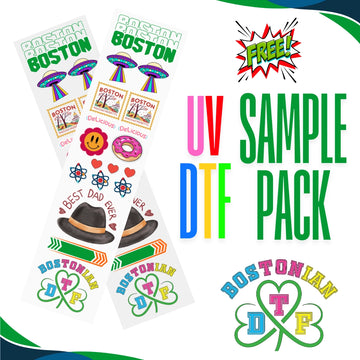
Yes. Sampling before a full order is strongly recommended, especially for unusual surfaces or first-time artwork. Add the sample option to your cart or contact us before ordering.
Who uses 3D UV DTF printing in Boston?
Candle makers, cosmetic and skincare brands, cafés and restaurants, salons and barbershops, gyms, bakeries, print shops, event planners, corporate gifting teams, nonprofit organizations, student groups, and local product sellers across Boston, Greater Boston, and Massachusetts.
How fast can I get my order?
Standard turnaround is 10 business days after artwork approval. Rush options may be available, contact us before ordering if you have a hard deadline. Boston local pickup is available by appointment.


