





DTF Supplies in Boston for Reliable Transfer Printing
- Featured
- Most relevant
- Best selling
- Alphabetically, A-Z
- Alphabetically, Z-A
- Price, low to high
- Price, high to low
- Date, old to new
- Date, new to old
Recently Viewed Products
DTF Supplies: the ink, film, adhesive powder, maintenance products, and production tools behind every Direct to Film (DTF) transfer are what actually determine whether your finished shirts look sharp or look like a problem. Not the artwork. Not even the printer. The supplies. Get those right, and the rest of the workflow follows. Get them wrong, and you will be reprinting orders you already pressed.
For Boston print shops, clothing brands, and small apparel businesses running real production, explore the DTF printing supplies collection at Bostonian DTF: sourced for professional workflows and backed by a team that actually presses transfers every day.
Before You Stock Up
What do DTF supplies include? Ink (CMYK plus white), coated transfer film, hot-melt adhesive powder, curing equipment, a heat press, RIP software, and maintenance products. Every stage of the workflow needs its own material.
What makes DTF printing supplies different from buying random consumables? Compatibility. Ink, film, and powder need to work as one system. Mismatched materials cause color shifts, nozzle blockages, poor film release, and transfers that peel after two washes.
Is there a minimum order? No. Order what you need now, test it, then restock based on real production volume.
Does Boston's weather affect supply storage? Yes. Massachusetts summers are humid, and winters are cold. Both affect ink viscosity, film moisture absorption, and powder clumping. Storage conditions matter here more than in drier climates.
What is the safest way to handle printing materials? Follow each product's safety data sheet, use proper ventilation, and store inks and powders away from heat sources. OSHA's printing industry safety guidelines outline chemical hazard controls relevant to small print shops.
What Does a Complete DTF Supplies Setup Actually Need?
A lot of buyers order ink first and figure out the rest later. We get it: ink feels like the obvious starting point. But direct to film supplies work as a chain, not a checklist. If one link is weak, the whole print suffers.
Here is what a production-ready DTF setup requires at every stage:
|
Production Stage |
Required Supply |
What to Verify |
|
Artwork preparation |
RIP software |
Color profile and white layer output |
|
Printing |
DTF printer supplies: CMYK + white ink |
Nozzle condition, ink flow, white opacity |
|
Transfer preparation |
DTF film supplies: coated PET film |
Correct print side, peel type (hot/cold) |
|
Adhesive stage |
Hot-melt adhesive powder |
Even coverage, correct particle size |
|
Curing |
Oven, shaker, or curing unit |
Consistent temperature and dwell time |
|
Application |
Heat press |
Accurate temp, pressure, and timer |
|
Maintenance |
Cleaning solution and tools |
Printer-safe formula, head compatibility |
A heat press running uneven pressure ruins a good transfer. A curing unit running five seconds short weakens adhesion across the whole batch. These are not advanced problems: they happen in real shops every week when one supply in the chain is wrong.
Breaking Down the Core DTF Printing Materials
Every consumable in a DTF setup has a specific job. Understanding what each one does makes it much easier to diagnose problems when they show up- and they always show up eventually.
DTF Ink: Color and White Work Together
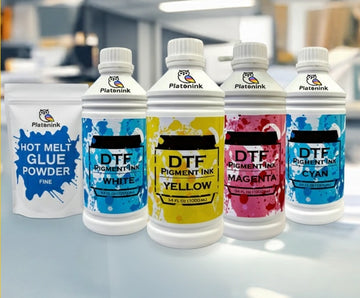
DTF ink supplies run on five channels: cyan, magenta, yellow, black, and white. The color channels produce the visible artwork. White ink creates the opaque underbase beneath it: without that layer, your design disappears on anything darker than a white tee.
White ink is also the most demanding material to manage. Its pigment particles are heavier than color ink, which means they settle during idle periods and can clog printheads if the printer sits unused for more than a day or two. Regular ink circulation and daily nozzle checks are not optional. They are how you keep a working printer working.
Transfer Film: Not All Coatings Are Equal
DTF film supplies provide the coated surface that holds the printed image before it gets pressed onto the garment. Film quality directly affects how cleanly ink sits, how evenly powder adheres, and how smoothly the carrier peels after pressing.
Films come with different peel specifications: hot peel, warm peel, and cold peel. Each requires a different post-press process. Using a cold-peel film with a hot-peel workflow causes partial lifts and edge peeling, even with perfect ink and powder. Always follow the peel spec on the film you ordered.
Adhesive Powder: The Bond That Makes It Last
Hot-melt adhesive powder bonds the printed transfer to the fabric during heat pressing. Particle size, coating consistency, and curing level all affect wash durability and how the finished print feels on the garment.
Too little powder creates weak adhesion spots. Too much leaves rough edges or stray adhesive outside the design area. Even application- either by hand shaking or an automated shaker unit- is what separates a transfer that lasts 50 washes from one that starts lifting after five.
How Do You Choose a DTF Supply Store That Actually Knows Production?
Price is not the right filter. A cheap ink that clogs your printhead after a 200-sheet run costs more than premium ink at three times the price. The math is not subtle.
A useful DTF supply store should provide clear product descriptions, printer compatibility information, peel specifications, storage guidance, and accessible support for real production questions. If the store cannot tell you whether their film is compatible with your specific printhead and curing setup, that is information you need before you order, not after.
The compatibility check that saves money
Before ordering any new DTF transfer supplies, verify: printer model, printhead type (XP600, i1600, i3200), ink system format, film width and peel type, curing method, and press workflow. When switching suppliers or trying a new batch, run a short test before moving into full production. Check white opacity, color accuracy, powder coating, film release, transfer stretch, and wash durability on at least one shirt before pressing thirty.
What Do Boston Print Businesses Actually Need?
According to the City of Boston, the city is home to over 18,000 small businesses that employ 127,000 people and generate close to $28 billion each year. A meaningful share of those businesses run custom apparel, branded merchandise, and event print work, and many of them are in neighborhoods where seasonal demand swings hard.
A shop in Dorchester running restaurant staff tees, a Roxbury brand doing a streetwear drop, a South Boston gym outfit hitting their fall uniform order, a Somerville creative studio pressing event merch for a weekend market in Cambridge... these are not the same orders. But they all need the same thing: professional DTF supplies that show up, work correctly, and support a fast turnaround.
Graduation season, Boston Marathon weekend, sports seasons, and summer outdoor markets all create demand spikes. The shops that handle those spikes without scrambling are the ones that planned their supply inventory before the rush, not during it.
DTF Printing Accessories: The Small Stuff That Prevents Big Problems
DTF printing accessories rarely make it onto a supplies checklist. Heat-resistant tape, parchment and Teflon cover sheets, lint rollers, film cutters, powder trays, measuring tools, cleaning swabs, gloves, and labeled storage containers all feel minor until the day you need one and do not have it.
A straight film cut saves transfer material and press time. A Teflon sheet protects the press platen from stray powder and ink. A lint roller removes fabric fibers from the garment surface before pressing: fibers under a transfer cause bubbles and adhesion gaps. These are not premium extras. They are basic risk controls that cost a few dollars and prevent batches that cost much more.
How Should You Handle and Store DTF Printing Essentials?
Boston's climate creates real storage challenges. Summer humidity swells film rolls and accelerates powder clumping. Winter cold thickens ink and can compromise adhesive bonding if materials are stored in an unheated space. These are not edge cases: they are what happens in real Massachusetts print shops every season.
DTF printing essentials storage basics:
-
Keep ink sealed and stored at the temperature range specified on the product label. Most DTF inks perform best between 60 and 77°F.
-
Store film flat or on a horizontal roll holder, away from direct sunlight and moisture. Film stored upright or bent will show creasing during the print run.
-
Keep adhesive powder in a sealed, dry container. Moisture causes clumping that leads to uneven coating and rough texture on finished transfers.
-
Use older stock first. Rotate supplies by arrival date and reorder before you reach zero on any essential material.
-
Never mix unknown ink systems without confirming compatibility. Different formula bases can react poorly inside a printhead.
-
Store cleaning solutions, inks, and powders separately from food, drinks, and personal items. Follow each product's safety data sheet for chemical hazard handling.
Per OSHA's printing industry guidelines, proper ventilation, personal protective equipment, and chemical storage protocols apply to print workplaces: even small ones. A 400-square-foot shop in Jamaica Plain is still a printing workplace.
How Much Should You Order When You Buy DTF Supplies?
Buy too little, and you run out mid-batch. Buy too much, and you store supplies past their usable period. Neither is good.
The honest answer is: track what you actually use first. Run two or three production weeks and count how many milliliters of white ink, how many meters of film, and how much powder you go through per 50 transfers. Then order based on that number plus a 20 to 25 percent buffer for unexpected demand spikes.
When you buy DTF supplies in bulk, confirm storage capacity, the product's shelf life, and your printer's daily consumption rate before committing to a large order. DTF ink supplies in particular have a limited usable window once opened. A liter of white ink that sits unused for three months while you figure out your workflow is not a bargain.
"The transfer does not start at the heat press. It starts the moment you choose the right ink, load the right film, and coat with the right powder. Everything after that is just confirming what you already set up correctly." - From the press floor
Frequently Asked Questions
What supplies are required for DTF printing?
A complete setup requires compatible color and white ink, coated transfer film, hot-melt adhesive powder, curing equipment, a heat press, RIP printing software, and maintenance products including cleaning solution and cover sheets.
Why does white ink behave differently from color ink in DTF printing?
White ink contains heavier pigment particles that settle during idle periods and can clog printheads without regular circulation. Daily nozzle checks and ink agitation are standard maintenance steps for any DTF printer running white ink.
How does Boston's climate affect DTF supply storage?
Summer humidity can cause film absorption and powder clumping. Winter cold affects ink viscosity. Store all supplies at manufacturer-recommended temperatures in a climate-controlled space: particularly important for Boston shops using unheated storage areas.
Can I mix different DTF ink brands in the same printer?
Not without confirming compatibility first. Different ink formulas can react poorly, cause nozzle blockage, or alter color output in ways that are difficult to diagnose. Test any new ink system in isolation before combining with existing stock.
What is the difference between hot-peel and cold-peel DTF film?
Hot-peel film is peeled immediately after pressing while still warm. Cold-peel film must cool fully before the carrier is removed. Using the wrong peel method for the film type causes partial lifts and edge peeling regardless of ink or powder quality.
How do I know when to reorder DTF printing supplies?
Track weekly consumption across ink, film, and powder. Reorder when stock drops below a two-week buffer based on your average weekly usage. Waiting until you run out during a production run is the most expensive way to manage inventory.
Shop DTF Supplies for Your Boston Printing Workflow
Whether you are restocking ink for a steady weekly run, sourcing film for a large seasonal order, or building your first complete setup, the right DTF printing materials make the difference between a smooth production week and a stressful one.
Shop the full DTF supplies collection at Bostonian DTF: ink, film, powder, maintenance products, and DTF printing accessories built for Boston apparel businesses that need consistent, professional results. Fast shipping across Massachusetts. No minimums. Order what you need, when you need it.