



UV DTF Transfers in Boston for Custom Hard-Surface Branding
- Featured
- Most relevant
- Best selling
- Alphabetically, A-Z
- Alphabetically, Z-A
- Price, low to high
- Price, high to low
- Date, old to new
- Date, new to old
Recently Viewed Products
People search for what is a UV DTF transfer and land somewhere confusing. Half the results describe it like science. The other half describe it like magic. The truth is somewhere in between, and it is much simpler than either version.
A UV DTF transfer is a peel-and-apply graphic for smooth hard surfaces: glass jars, acrylic signs, coated metal bottles, ceramic mugs, rigid plastic cases, product packaging. The design is printed with ultraviolet-cured ink onto specialized film, applied to the object with firm pressure, and the carrier layer peels away to reveal only the graphic. No heat press. No weeding. No vinyl cutting. Just... press, peel, done.
For Boston businesses, product makers, print shops, and event teams that need full-color hard-surface branding, explore the UV DTF transfer sticker collection at Bostonian DTF, backed by a production team that handles orders for brands and makers across Massachusetts every week.
Before You Order
What is a UV DTF transfer? A peel-and-apply hard surface graphic made with UV-cured ink on specialized film. Only the printed design remains after application. No background, no clear border, no thick vinyl layer.
Does it need a heat press? No. UV DTF heat transfer is a common search phrase, but UV DTF is not applied with heat. Firm manual pressure bonds the transfer to the surface.
What surfaces work? Clean, smooth glass, acrylic, ceramic, coated metal, rigid plastic, and sealed packaging. Rough textures, rubber, silicone, flexible materials, and soft-touch coatings need testing first.
Can I use it on shirts? No. Transfer DTF UV products are for hard goods only. For fabric, use apparel DTF transfers with a heat press.
What is a gang sheet for UV DTF? A single large film sheet containing multiple designs, logos, labels, names, or sizes nested together for one production run.
What Actually Makes UV DTF Different From a Regular Sticker?
So here is the thing most people miss. A standard sticker has a background. Even "clear" vinyl stickers carry a clear film layer that catches light, shows fingerprints, and creates a visible edge around the design. You can always tell it is a sticker.
A UV DTF transfer leaves only the ink on the surface. No background. No border. No carrier film remaining. The design sits directly on the glass jar or acrylic sign and looks like it was printed there. It is closer to a custom-printed product than a sticker, which is why boutique brands, local makers, and premium packaging shops reach for this method when presentation matters.
How the UV Curing Step Changes Everything
The ink used in transfer dtf uv production is cured by ultraviolet light during printing. That means the graphic is already hardened and adhesive-ready before it ever touches your product. There is no waiting for liquid ink to dry, no smearing during handling, no fading from ambient light during production.
A clear varnish layer can also be applied on top of the design, adding gloss, a soft matte finish, or even a raised tactile texture depending on the print configuration. That versatility is part of why UV DTF has grown so fast in the custom branding space.
UV DTF vs Apparel DTF: Which One Do You Need?
This question causes real confusion, and it is worth clearing up completely before you order anything.
|
Feature |
UV DTF Transfer |
Apparel DTF Transfer |
|
Target surface |
Hard goods only |
Fabric (cotton, poly, blends) |
|
Application method |
Firm manual pressure |
Heat press required |
|
Common products |
Jars, bottles, signs, cases |
Shirts, hoodies, tote bags |
|
Finish |
Glossy, matte, or raised options |
Flexible printed adhesive layer |
|
White ink use |
Makes design visible on dark surfaces |
Creates underbase on dark garments |
|
Heat press needed |
No |
Yes |
|
Best choice for packaging |
Yes |
No |
|
Best choice for apparel |
No |
Yes |
The garment, the surface, the end use. Those three factors decide which method is correct. Neither replaces the other. Ordering the wrong type wastes both the transfer and the blank, which... yeah, we have seen it happen.
What Can Boston Businesses Brand With UV DTF Transfers?
This is where it gets fun. Because the use cases around Boston are genuinely diverse, and UV DTF transfer stickers fit a lot of them.
A candle maker in the South End applying logo decals to glass jars for a Newbury Street stockist. A Cambridge skincare brand testing small-batch bottle labels before committing to custom-printed containers. A North End café branding seasonal ceramic mugs for a local gift shop. A Seaport event team labeling acrylic signs, favor boxes, and sponsor bottles for a corporate waterfront event. A Roxbury nonprofit creating branded tumblers for a fundraising campaign. A South Boston gym pressing shaker bottle decals for a member loyalty program.
Where the Demand Peaks in Boston
According to the City of Boston's Office of Small Business, Boston supports entrepreneurs through every growth stage with tools, networking, and technical guidance. For product-based businesses, that growth often means moving from outsourced packaging to in-house branding. Transfer UV DTF sticker production makes that transition practical for small batches and short runs.
Boston's event calendar amplifies demand significantly. The Boston Marathon draws tens of thousands of spectators and runners each April, with branded merch and event giveaways ordered months ahead. Summer outdoor markets, university welcome weeks across Cambridge and Allston, and holiday retail seasons in neighborhoods from the South End to Jamaica Plain all create consistent spikes in hard-surface branding demand.
How Does a UV DTF Gang Sheet Work?
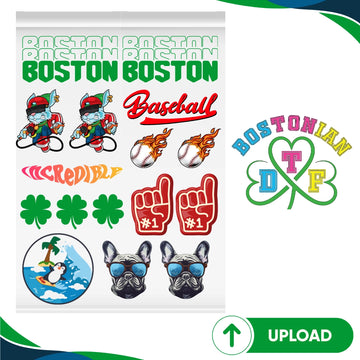
A gang sheet holds multiple graphics on one larger film. Instead of ordering each design as a separate transfer, you nest logos, labels, names, sizes, and seasonal artwork together into one sheet. One production run covers everything.
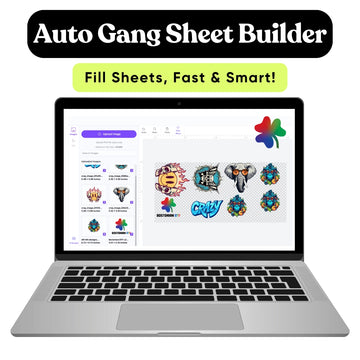
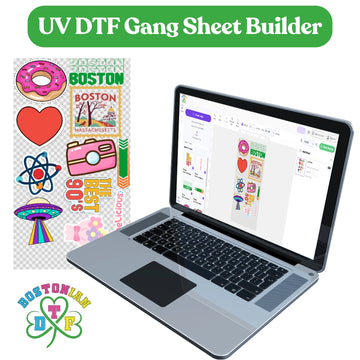
Our collection offers a gang sheet builder for separate artwork files plus a direct upload option for pre-built layouts. Narrower sheets work well for small test runs and mixed-size labels. Wider sheets are better for repeat logos and larger production batches.
How to Arrange a Gang Sheet That Actually Works
Start with your largest graphic. Fill remaining space with smaller logos, label sets, and accent marks. Leave practical cutting room between designs — packing them edge-to-edge saves film but makes clean trimming nearly impossible.
Check every design for final print dimensions before submitting. A design that looks right at 100% zoom on a laptop can be undersized for a real bottle when the measurements are checked. Size for the actual surface, not the screen.
What Surfaces Need Extra Testing?
Smooth, clean, non-porous surfaces are where UV DTF transfer stickers perform best. Glass, acrylic, coated metal, ceramic, rigid plastic, and sealed product boxes all tend to bond well with proper surface preparation.
The surfaces that need real testing before bulk orders: powder-coated finishes, soft-touch plastic coatings, textured or embossed packaging, silicone, rubber, flexible squeeze bottles, untreated wood, and low-energy plastics like some polyethylene containers. The adhesive may not reach a textured surface fully, and edges may lift along curves or ridges.
Tight curves and narrow necks also create challenges. A gently curved bottle body usually works. A sharp ridge, a flexible squeeze section, or a neck narrower than the design definitely needs a test piece first.
What Makes Artwork Ready for UV DTF Printing?
Clean files produce clean transfers. That is the whole rule, really.
Use vector artwork where possible. For raster files, 300 DPI at final print size is the baseline. Not 300 DPI on a tiny thumbnail that gets scaled up during layout — final print dimensions at full resolution.
The Details That Catch People Out
Check transparent areas carefully. A PNG that looks clean in design software can carry invisible artifacts, faint bounding boxes, or compression noise that only becomes visible at print resolution. Check white elements too. White ink makes a design visible on dark surfaces, but unintended white areas in the file will print as opaque white, which may not be what the layout requires.
Small text below about 6pt and very thin lines below 0.5pt can lose definition during UV DTF production. Bold, clean typography and strong shapes press better than delicate scripts at small sizes. If the text does not read clearly at the actual print size on screen, it probably will not read clearly on the transfer either.
"No printer can invent resolution that is not in the file. What you upload is what you get; so upload the right thing."
How to Apply a UV DTF Transfer Correctly
Application is straightforward, but rushing through it is where most problems start.
-
Clean the surface with isopropyl alcohol and let it dry completely. Oil, dust, fingerprints, and moisture all compromise adhesion.
-
Peel the backing from the transfer film.
-
Position the design on the surface before committing to full contact.
-
Apply firm, even pressure across the entire design using a squeegee, credit card, or application tool.
-
Work from the center outward to push out any air pockets.
-
Peel the carrier film back at a low angle, slowly and with consistent tension.
-
If any part of the design lifts with the carrier, lay it back down and re-burnish that area before continuing.
Fine lines and small text require extra pressure during burnishing. Those elements are most likely to stay on the carrier if the adhesive did not make full contact with the surface.
Care and Durability: What to Tell Your Customers
Durability depends on the surface, the application quality, the environment, and how the finished product is used. A clean transfer on a smooth glass jar handled with care is very different from the same transfer on a gym shaker bottle going through a bag every day.
For drinkware and washable goods, hand washing with mild soap is the safer care recommendation unless dishwasher performance has been specifically tested on the exact product. Avoid soaking, harsh abrasives, sharp tools, and strong solvents.
Keep transfers away from food-contact areas and drinking rims. Do not describe a product as waterproof, dishwasher-safe, or permanent without testing the specific combination of transfer, surface, and cleaning conditions. OSHA's printing industry guidance also notes that print workplaces should follow safe handling practices for UV inks and adhesive materials during production.
Frequently Asked Questions
What is a UV DTF transfer?
A UV DTF transfer is a graphic printed with UV-cured ink onto specialized film and applied to smooth hard surfaces using manual pressure. Only the printed design remains after application. No background, no border.
Does a UV DTF transfer need a heat press?
No. UV DTF transfers are applied with firm manual pressure. They are designed for hard surfaces and do not require the heat press used for apparel DTF transfers.
What surfaces work best?
Smooth, clean, non-porous surfaces including glass, acrylic, coated metal, ceramic, sealed packaging, and rigid plastic. Textured, flexible, rubber, silicone, and soft-touch surfaces need testing before bulk orders.
Can UV DTF transfers be used on shirts?
No. UV DTF is for hard surfaces only. For apparel, use standard DTF transfers with a heat press.
Are UV DTF transfer stickers waterproof?
They resist moisture on compatible surfaces when properly applied, but waterproof and dishwasher-safe claims should only be made after testing the exact finished product.
What is a UV DTF gang sheet?
A gang sheet holds multiple designs on one larger film, allowing you to print mixed logos, labels, sizes, and artwork in a single production run.
What file format works best for UV DTF printing?
Vector files are preferred. For raster artwork, use 300 DPI at the actual final print dimensions.
Can UV DTF be applied to curved products?
Many gentle curves work well. Tight curves, ridges, flexible sections, and narrow necks should be tested before committing to a full batch.
Order UV DTF Transfers for Boston Hard-Surface Branding
Need full-color decals for bottles, jars, acrylic signs, packaging, mugs, phone cases, or branded event products? Shop the UV DTF transfer collection at Bostonian DTF. Build a custom gang sheet, upload a ready-made layout, or start with a short test run. Fast shipping across Massachusetts. No minimums. Press, peel, and brand with confidence.